Wednesday, March 24, 2010

Metamorphoses, the last prayer.

Finally, our story (or again, should I say play?) comes to an end, a rather interesting end in my opinion. I was glad that it ended with a story that kind of incorporated all the themes and values of the whole thing. Again, I saw how the story criticized humans and their selfishness but also showed how not all of them are like that.

As a finally story, Zeus and Hermes want to see what the human world is all about and dressed up as beggar they start knocking on peoples doors to ask for shelter but no one help them.

“And a thousand doors were slammed on them.” Metamorphoses pg 77

Then just as they were going to give up, Zeus wanted to try one more door and the couple living in it decided to help them and gave them shelter and food. Later, the couple is rewarded by the gods by giving them lots of riches and granting them a wish. After thinking about it the decide they want to die together so one won’t be left behind, in the end everyone joins in and they have a last prayer towards the gods.

In this last reading I liked that in the end the gods could see that humans weren’t all bad and it was the least expected who could show kindness.

“Hermes: Why bother knocking here? We’ve knocked on houses of all kinds, the homes of people with plenty to spare. Whoever lives here obviously has nothing.

Zeus: Let´s give it a try all the same. We´ve come all this way.”

Again the gods rewarded the ones who showed a kind heart. Also I liked the phrase were it says that a 1000 doors were slammed in their face, it was something very human. Persistence, that eventually you will make it, it is something others would call stubbornness.

Anyway, in the end as I said before I liked that all the characters came out and said the prayer to the gods. I thought it was a really nice touch for the ending.

“All: Let me die the moment my love dies.
Narrator 1: They whisper
All: let me not outlive my capacity to love.
Narrator 1: They whisper
All: let me die still loving, and so, never die.”

This video shows what Zeus and Hermes did, being gods, they dissguised themsleves and no one treated them as they should. If you skip to minute 7 you will see how his happens the same way to a princess.

Tuesday, March 23, 2010

Phaeton summary


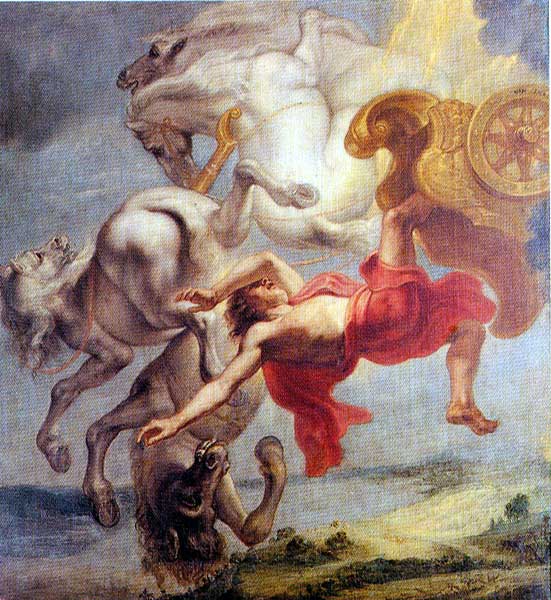
Upon a Little Brats request the whole
World lay at his feet in fires glow.

New ways of story telling

These past two stories weren’t narrated to us in the common way that the play had been using up to now.

The story of Phaeton, the story that tells how Apollo’s son burns the whole earth to ashes, is told as if he went to a psychologist and was telling the story to the person. It sounded in a way very updated and modern which was a little strange.

Then the story of Eros and Psyche that tells how the son of Aphrodite falls in love with Psyche. His love is forbidden by his mother because she says Psyche only would like him because he is a god. To prove her wrong he takes Psyche and makes her fall in love with him but never letting her see him. Still, a small mistake from her part and their love was almost enough to break them apart but she showed courage and in the end Zeus gave her her love back and made her immortal. What is strange here is that while the story unfolds, it is a conversation between two people who seem to know a lot about the people in the story. It reminded me of a grandfather telling its grandchildren an old story.

Other than the strange new way the narration of the story is going, I found one part of Eros and Psyche interesting. It was another moment where people are shown as both virtuous and full of flaws. When Psyche suffers and suffers for her mistakes but is later rewarded.

“A: She finishes her tasks and Zeus declares enough´s enough
Q: He overrides Love´s mother?”
A: Yes. And further, he gives Psyche a special potion and she becomes immortal. Then he declares that their marriage will last forever.” Metamorphoses Pg: 75

Until lately we have seen how messing with the gods can cause a lot of pain and punishment, but as we see know it can also bring you big and great things as rewards if you prove yourself worthy of receiving it, if you show the gods that you are virt

uous and will fight for what you love.

Reccuring Themes!

Vertumnus wooing Pomona


The very first thing I noticed about Pomona and Vertumnus was that up till now it has been the only story that had another story inside of it.

“Vertumnus: Listen, aren’t you afraid of offending Aphrodite? Don’t you know the story?
Pomona: what story?
Vertumnus: the story of Cinyras, his daughter Myrrha, and Aphrodite?” metamorphoses pg42

I studied once something similar in Don Quixote where in the story that is being told, the characters tell another story that seems to be told by the same narrator who is telling us the first story but is still part of the plot and sometimes necessary for the original story. Like in this one the story being told inside the story is a way to teach the characters about someone else’s mistakes.

Vertumnus, wanting Pomona’s love and attention, tries to tell her the story of Myrrha who didn’t fall in love. She thought she was above that feeling, and in punishment the goddess of love, Aphrodite, made her fall in love with her father.

“You can shut yourself in a room, bolt the door,
But love will come through the window.
Draw the curtains, lock the casement,
But love will seep through the walls.
Never think, never think that you can be safe from love.” Aphrodite pg 53 metamorphoses


Vertumnus intentions were actually to make Pomona notice him as a good suitor and in the end he manages his goal. But it wasn’t the story that made him win over Pomona’s love, she liked him just for what he was and not because he tried to lecture her about how she had to love someone or Aphrodite would give her a deep misfortune.


In Myrrhas story I noticed a recurring theme again. I saw how Aphrodite showed anger at someone trying to ignore love and acted by punishing the person, something that Ceres did to Erisichthon. As I mentioned before I like when gods have human characteristics and having it come more than one time in the whole play was great.
Myrrha turned into a tree

Wednesday, March 17, 2010

Humans and Gods... as different as we think?


Erisichthon eating uncontrollably

Again, in these readings I saw how important the gods were to the story and in this one, Erisichthon, I could see a very human side of them.

The first story is about a man who scorned the gods. He didn’t care about them and didn’t respect them at all. But one day he insulted the goddess Ceres by cutting down one of her sacred trees. Angry and vengeful, Ceres set Hunger on him, who made him eat and eat without ever satisfying his deep hunger. It even lead him to sell his own mother who fortunately believed in the gods and was aided by Poseidon. But the godless Erisichthon ate until he died.

My first impression of this story was that Ceres acted out of anger because she felt disrespected and had no mercy on Erisichthon by sending such a human pain as hunger to destroy him. She is in a way just a very powerful and proud human. She has no boundaries which is why she could call something like hunger to punish someone who had wronged her.

As a teaching, they involved Erisichthon mother (who did believe in Poseidon) as a comparison from people who pay tribute to the gods and those who don’t. How the ones who do will end well, their misfortunes forgotten and how the ones who don’t won’t do very well in life.

Also, I noticed that the tale explores the human evil and virtues. In many of these stories we see both people who are good and others who are bad. In this case the main character was bad with the gods, and got what was coming to him. Now in the next story something similar happens, human curiosity and insecurity caused Orpheus to lose his wife.

At the wedding of Orpheus and Eurydice she is killed. Orpheus is so depressed he goes to the underworld to beg Hades to give him back his wife, he agrees but tell him that he must leave, that she will follow, but if he looks back to see her before he is out of the underworld she will be turned back and he will leave without her. You can probably tell that Orpheus looked back and lost his loves life. Again a human characteristic is put to the test and it shows how it can be such a great weakness that it can even make us bet on something we love dearly.

Eurydice being lost to the underworld after Orpheus turned around.

Alcyone and Ceyx (Greek Gods)

Alcyone not wanting her Husband to leave
So, with this new book, or should I say play, I am looking forward to keep on reading because I worked in an actually theatrical play were this was the topic. It was quite interesting and by the end of the play I was almost able to recite most of the lines in the stories, but now, I’m actually reading the text and it is a very different experience and I hope I can get more form it than last time even though watching the play was special and entertaining.

This play touches a topic I have always been interested in which is Greek mythology. Normally I’m not really into religious things, but the idea of gads that are very human like attracts me very much, even as a kid when my father told me about the lessons you could learn from Greek stories such as the one I just read of Alcyone and Ceyx, gods who are forgiving as they are judgmental, in this specific story the gods play an important role in the plot of this story.


We are told about a couple, Alcyone and Ceyx, one day Ceyx has to leave his beloved wife and even though she begs him not to go, he leaves and in a series of unfortunate events that involved one of the gods, Poseidon, god of the seas, sent a storm on Ceyx´s ship and made it sink. Back at land Alcyone waited for her dead husband desperately counting the seconds until he arrived. Here, the goddess Aphrodite saw this and took pity on Alcyone, and through other gods, she managed to send her an illusion of her husband that showed her he was dead, and even after she chased the illusion the gods gave her his body back, and even turned them both into birds so they could live happily ever after.

So you see, without the intervention of the gods, the story couldn’t have happened in the same way. I also noted that it was both the gods fault for the Sad parts and the happy parts in the book, they are on no one’s side but their own, sometimes they even fight amongst themselves, if this doesn’t prove they are humans I don’t know what would.

Thursday, March 11, 2010

Metamorphoses, a new beginning.

Starting this new book, metamorphoses I felt confident because I have had a little background with it and have a little knowledge about it, but listening to it in both Latin and English was a weird and confusing combination, especially because I would get lost in the parts were Latin was the language and forget what was happening . Still, from what I understood Metamorphoses lives up to its name, at least “Creation” its first part does.

It’s all about how the earth was created, that it was a god that no one remembers which one it was. It talks about how he created at first the earth in a mighty ball so it would be equal in every side. This part I liked a lot because mentioning that the earth is equally round, that there is no side better than another is a good way to indirectly say that everyone and everything is equal. Also it mentions that he made someplace warm and others hot, some with snow and others without also making a comparison that at the beginning everything was in balance and equal nothing was more than another thing.

Also at first it tell show before the god intervened with it, earth was a dark and hostile place. This idea is kind of religious because a world with no god, is supposed to be something like that dark hostile place described at the beginning, but then again Metamorphoses looks like something were we will learn lots of life lessons on.

I look forward to keep reading (or listening) Metamorphoses, it seems that it could turn interesting in a while, I think it will be one of those texts that start out a little slow but then turns interesting as it tries to explain some of the world’s best kept secrets.

Monday, March 8, 2010

The Bhagavad-Gita Concluding


It was only at the end of The Bhagavad-Gita that I finally understood that all that was happening wasn’t what was expected. First I would like to say that I love when a book gives me a surprise because normally I always guess the things before hand so the book will seem very boring and monotonous, filled with social clichés and predictable plots, but this one of the rare and few that also stay in my head for some time. I liked the end especially because it one of those books that you need to read till the end and then you see how it all comes together in an unexpected way.

In the end I could see that Krishna’s whole point was to teach Arjuna not induce him into battle, he taught him necessary from unnecessary and we got to see that it was not really his intention for Arjuna to just go and fight he wanted him to understand why he was fighting for, that it wasn’t personal gain, it was just his duty.

Honestly as I said before I really liked this book and even if it did disappoint me in some places ( I didn’t really agree with some of the ideas planted in the text) It was worth it.

Sunday, March 7, 2010

Bhagavad gita Conception of the Universe

You cant really see the picture( i cant fix the pixels) But in summary its just a box that says (Insert image of supirior being that only Arjuna has seen) And surrounded by words such as : Actions, Knowlege, Medetation, reincarnation, dicipline, illumination and delusion(crossed out)


Wednesday, March 3, 2010

Krishna the God, All Hail!

Finally my doubts were cleared, it seems that Krishna is in a way “supernatural” he is a divine spirit and in this teaching, and Arjuna tells him that he speaks of how he is such a great person and how everyone adores him so he asks Krishna to show his true self and Krishna does.

“But you cannot see me with your own eye; I will give you a divine eye to see the majesty of my discipline”

After Arjunas is authorized to see Krishna´s true form, he bows down and prays to him, worshipping him, and asking who this terrible being in front of him was. Now I see a big dilemma that might transform the plot, now that Arjuna knows that Krishna is a god, he will probably take his advice a lot more seriously and do whatever Krishna tells him to, on the other hand he could also just want to know more from him yet not follow his advice (I’m going with the follow the gods orders part though, at least right now).

Also Arjuna explains that he met Krishna and thought of him as a friend, but didn’t know of his glory. I think this is a bit strange because why would a god hide as a human and befriend a king to later refuse to fight? Maybe the god knew this and wanted to guide Arjuna in too the ways he thought were right. Arjuna asks the god to go back to his “human form” and the god told him that no one had ever seen his form before although many wanted to, I think in a way the god Krishna is interested in Arjuna and this is why the whole story develops and this is why everything is happening.

Next in Teaching 15, Krishna compares himself to everything that the Earth is, I think this a good comparison because in more than one religion the god or the superior being is the creator, someone to look up to and admire, a role model to everyone, a comparison (that in my opinion was really poetic and interesting) that involves one of the beliefs that unites most religions around the world is a something smart to write on a book that is supposed to be intended to teach people.

Tuesday, March 2, 2010

Teachings 7-9 Krishna and Arjuna continue Discussing

Krishna and Arjuna continue talking but mostly its Krishna who tries talking Arjuna into going to war.

Krishna is now talking a lot like he was a divine god, while he is advising Arjuna he tells him how man that are wide and disciplined have a good relationship with him. Here I got a little confused, I’m not sure if Krishna really thinks he is this great or that he is taking the role of a deity as an example to explain what his point is to Arjuna and make him go on to fight. I think it’s is more likely he is taking the role which is a very good strategy to try and explain something in a believable way to another person.

“But when they cease from evil
And act with virtue, they devote
Themselves to me, firm in their vows,
Freed from the delusion of duality.”


Here is one of the examples where we can see that Krishna takes a gods role. I agree with this quote, although not with many part of Krishna’s speech because I also think that when you forget your anger and evil you can be a lot happier and live better.

Now, the conversation both of the characters are having turned into more of a lesson because Arjuna now asks questions to Krishna, and by the way the text calls Krishna (lord Krishna) maybe I was too quick to think that this chariot driver isn’t in fact a god or someone superior to whom Arjuna asks questions and he has answers to deep as the ones he gives:

“Deluded men despise me
In the human form I have assumed
Ignorant of my higher existence
As the great lord of creatures.”


Anyway, god or not, Krishna talks about men being able to reach him, that those who do, don’t go back.

“It’s called eternal unmanifest nature,
What men call the highest way,
The goal from which they do not return;
This highest realm is mine.”


Something I found in these teachings were contradictions, first Arjuna says that the knowledgeable man is dear to him, but then later on in his speech he says:

“I am impartial to all creatures,
And no one is hateful or dear to me.”

As I have noticed many times lessons having to do with religious aspects often contradict themselves, but that is a different matter.

Now a song that could describe a little Krishna’s strange god or not form could be this one:


Monday, March 1, 2010

These teachings resume the discussion between Arjuna and his chariot man Krishna, again we see how they argue about what Arjuna should do, should he fight or should he not, should he be or should he not? Should he stay or should he go?


The whole discussion is about what choices people should make in life, when they are at that cross road that could decide your life (or in Arjuna’s case death) it’s something we can all relate to and see that it has happened to us once at least.

Something I found interesting about the third teaching was that Krishna quoted someone else, he was also talking about how in life you must take actions or it would be nothing, nothing would happen nothing would be accomplished and life wouldn’t move forward, something that relates to human nature which is also mentioned in Krishna’s arguing he talks about passion and desires and says that this is what causes man to be naturally evil, which in a way I think is true but not entirely, because if humans didn’t have any passion in them everything we would do would just be to do it nothing we like to do nothing to live for.

Also Krishna talks about knowledge and discipline which I think are important when decision making. He is trying to convince Arjuna that his knowledge will take him to choose the right path, which to him is to go on with the battle.