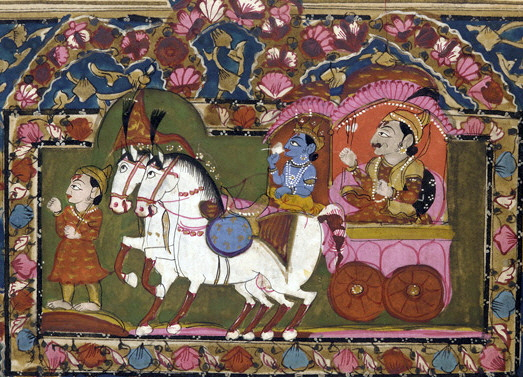
Sunday, February 28, 2010

Second Teaching

“Contacts with matter make us feel heat and cold, pleasure and pain. Arjuana you must learn to endure fleeting things- they come and go!” The Bhagavad pg.33

“When these cannot torment a man when suffering and joy are equal for him, and he has courage, he is fit for immortality.” The Bhagavad pg.33

When I first started reading this book I thought it was too much like the Iliad which wasn’t one of my favorites but after this reading I’m almost certain I’m going to love this book. All the arguments and how the characters discus is so different to all the normal conversations I’m used to reading in books that glorify killing, all these new ideas planted are very good and convincing even though they oppose what others think. Every other person in this story seems to think that war and killing is the best way to go but this Arjuna refuses to do something he doesn’t believe in.

Also the topic of immortality through acting or feeling a certain way comes up like in Gilgamesh and many other stories. Here they say that you can be at the level of immortality when you stop feeling so much and instead be strong, this isn’t too different to what others think reaching immortality requires either.

“Our bodies are known to end, but the embodied self is enduring indestructible and immeasurable; therefore, Arjuna , Fight the battle.” The Bhagavad pg.34

Here is another example of the interesting new ideas this book talks about. Their immortality is about their memory not themselves physically but rather more about who they were and what they did. It also talks about reincarnation in a way, it says that the soul will never be destroyed even if the body (or the shell) is, nothing can touch your soul.

Krishna is intensely trying to convince Arjuana to battle with arguments such as reincarnation that we will all die eventually, that he will look as a coward in front of everyone, that if he dies he will win heaven. He also talk about a state of mind were he reaches the best place to be, I think the character could mean what we think now a days as illumination, from the little Buddhism I know the description given in the book:

“When the suffering does not disturb his mind, when his craving for pleasure has vanished, when his craving for pleasures has vanished, when attraction, fear, and anger are gone, he is called a sage whose thought is sure.” The Bhagavad pg.40

Is very like the description I know about illumination, a place where materialism and things of no importance are forgotten.

“In serenity, all his sorrows dissolve; his reason becomes serene, his understanding sure.” The Bhagavad pg.41

“When he renounces all desires and acts without craving, possessiveness, or individuality, he finds peace.” The Bhagavad pg.42

“This is the place of the infinite spirit; achieving it, one is free from delusion; abiding in it even at the time of death, one finds the pure calm of infinity.” The Bhagavad pg.42

The Bhagavad, Beining and First Impression


This book starts off with a man asking another man how his sons were during war. As the story develops I found a similarity to The Iliad especially in the part where the speaker starts to describe the people who were beside the man’s sons, who they were and what their weapons were:

“Many other heroes also risk their lives for my sake bearing varied weapons and skilled in the ways of war.” The Bhagavad pg.24


At the beginning of the Iliad there is a similar description, it’s about all the people who are going to battle in the Trojan War. It explicitly describes the people, who they are their family lineage and weapons.

“Far enough for me to see these men who lust for war ready to fight with me in the strain of battle.” The Bhagavad pg.26

In this passage, and because the whole story begins with war it seems obvious that it’s an important part of the book, but also at the beginning there is one man who opposes war, he tell his charioteer that he find no good in war at all and he doesn’t want to kill anyone even if he is killed, this is new I had never seen a pacifist amongst the fighters in books like these it’s always about glory and killing, but now finally there is someone who doesn’t want this.

The names are a bit confusing, so it would be helpful to know and have notes about them:
Name Bank
Arjuana: “pacifist”
Ksishna: charioteer
Dhritarashtra: man asking about the war. It’s his son who are battling.
Sanjaya: man telling Dhritarashtra about his sons and the battle.

Sunday, February 21, 2010

Gilgamesh the ending

At the beginning of this tablet we are introduced to a brand new issue that leads to Gilgamesh and Enkidu reuniting. It was very interesting what Enkidu had to tell about the people from the nether world, about whom they were and what their other life was like because of who they were when they were alive.

“How is it with the man who has no son? I have seen the man. He sits by the wall and weeps.” Gilgamesh page 91.

Along with the descriptions of the people and their fortunes they show us what the underworld is like and that there are in fact many gods in the netherworld, plus we can see that people who are living and those who are dead can actually communicate with each other.

Over all I thought this book was very good and it gave me a new way to look at things such as friendship, and death. It was sad but it was easy to read and enjoy and you could relate to it since it used stories and elements we are familiar with.

This picture is titled “The Gate Hell” by Rodin. I had the privilege to see this piece of art in person and it represents many visions about hell, thought mostly the ones of fear and misfortune.

Thursday, February 18, 2010

Tablet 11


Word of the Reading

Kiln


Mainly in this tablet the topic of a big flood that covered the entire world but one man helped by a god builds a boat and carries pairs of creatures of the world and survives, the man was the same one that Gilgamesh was looking for so he would give him the secret of becoming immortal. This story is very similar to Noah’s ark but with some slight differences, in Noah’s he is told by god to build the ark just like in Gilgamesh’s but in this one the surviving man, Utnapishtim, was told only by one god to survive, the others were in disagreement of his survival, and because of it they made him immortal, now in the bible story I don’t remember anything about Noah becoming immortal. The stories, though similar, are different in many matters that make a whole difference in their meaning and resolution.

Wednesday, February 17, 2010

Tablets 9 and 10

Word of the Reading

Agate

Hematite

The first thing that I noticed when I read this tablet was that it appears as if Gilgamesh has passed a long time wandering until he finally made it to his goal which was to find Utnapishtim. It is really common to see a character that seeks immortality I have seen it in many other cases, but what makes this Gilgamesh special is that he is not entirely human, as it is revealed now why he is part god, and it’s because his mother was a Goddess and his father was human. Someone who was also part god in Greek mythology is Hercules, but he went on quests to prove himself to his father, Zeus that he was worthy of becoming a full god, on the other hand Gilgamesh seeks immortality because he does not want to end up like Enkidu, dead.

Going back to Gilgamesh’s origins I found it strange that his mother was the goddess since it is more common that it is the father of someone who is part god to be the immortal one and the mother the human. I liked this detail in the story because it’s good to know that not all stories follow the same path, even if they are classics or myths from ancient societies.

A special detail I also found was that the dark path that Gilgamesh has to pass through to reach his goal is described as the path that the sun takes when it’s not lighting the earth, this is a great example of people trying to answer many of the questions from the world we live in, they came up with the theory that the sun is passing through a dark passage and this is why it doesn’t shine during daylight.

Tuesday, February 16, 2010

Tablets 7 and 8

Word of the Reading


Brood

Enkidus death is a great change in the story since he is one of the main characters of it. We could see that during his last moments he both cursed and bless different people who were influential in his life. At first he was cursing the temple prostitute and the hunter he knew, but after a while he backed down and decides to wish them no harm. I think that before he died he wanted to go away without any bad feelings or resentment, but it is impossible to know anyway.

It surprised me how Gilgamesh took Enkidus death, he first was extremely sad and he gave him the proper treatment and offerings, but later he decided to build a monument in his honor, something Enkidu was worried about, that he would be forgotten and that everyone would only notice Gilgamesh and not remember Enkidu his loyal companion.I guess in those times getting a monument build in your honor was a great way of people remembering you as an important person and it was probably a great way to show someone else how much you cared about them if you build something big and probably heavy for them even after they are dead.

On the video attached you can see another way too look at death that I find very helpful, even if it is meant for children.

Monday, February 15, 2010

Tablet VI

Word of the reading

Contrivances

Loam

It is strange that when the goddess Ishtar talks to both Gilgamesh and Enkidu, it is Enkidu who fights her and aggravates her when it is Gilgamesh that should be fighting her, this shows how their friendships is strong and they are there for each other even though the problem doesn’t really concern one of them.
When Ishtar is going to release the Bull she is warned that this will harm the people and they will suffer from hunger and lack of food, but she says she is ready and can sustain these people. Her way of taking responsibility for her actions is strange because it is not at all how Gilgamesh described her to be, she is a complex character that is willing to hurt just as much as help others.
Also the fact that the beast that the goddess sends to punish Gilgamesh is a bull that is slain by the two friends, when throughout the book they are both compared to a bull before maybe its to show a little irony or maybe to represent how their team work can overcome something as powerful or even more powerful than themselves.

Tuesday, February 9, 2010

Gilgamesh tablets IV and V

Words of the Reading

Libation1

In this reading I saw a very interesting thing that happened between Gilgamesh and Enkidu, and it happened that when each of them saw the face of the demon they were chasing they both ran and cowered in fear, but the other one would come up to them and tell them that together they could face of the fear and defeat the enemy. This aspect of friendship that I saw between them was amazing to be because they both seem to know the importance of friendship and team work, of support and of guidance of others who are in fear or weaker than you, and for these two characters it worked because instead of dying in the forest were no one could live though, working together and using both of their skills they managed to kill the demon and live to tell the tale.
Also I noticed that it was one of the gods, or deity helped them to complete a very dangerous tasks .I have seen this before in Greek mythology, gods helping mortals to do things that seem impossible, I think that these similarities have something to do with each other, I doubt they are simple coincidences.

Monday, February 8, 2010

Gilgamesh, Tablets II and III


Word of the reading:

Anointed 1


Something noticed in the reading was that the names of people and the descriptions of them are repeated constantly. I have seen this technique in other books I have read that are old, or at least older than most books we read today. One of these books was the Iliad written by Homer, the names and special characteristics given to the characters though the names, they can be called the strong, the witty, or anything that describes them and will let others know who they are or what they do. Actually, this could be like labels we used today to classify people.

Sunday, February 7, 2010

Amazon

How did we get here?
We got here just like any other thing alive on earth, our earth that gives us everything necessary to live and sustain ourselves.

Who are we?
We are living creatures on earth, on the same level as all of nature’s creatures; we live together and depend on each other to survive.

Where are we going?
Our community tries to keep its ways but we struggle doing so, other cultures put pressure on us because they want us to change, maybe because they want our land, maybe because they want everyone to be like them, there are many reasons why but if we keep this up we will all end up being the same, there will be no difference in culture or ways of thinking

Why is the world unjust?
The need of things that we don’t really need to live happily with makes people think they live in an unjust world. Unfortunately this wanting of things that really aren’t necessary cause our recourses damage, which leads to the a shortage of the things we really need. If people could understand that they need only a few things to live and let everything else alone then they could start realizing that they don’t really live in an unjust world, that it is just chance and that we should enjoy everything that happens in our lives until it’s over.

Why are we here?
We are here to learn how to live with each other and nature. We must realize this unless we want our world to be ruined forever. We aren’t here to make the world ours, we must live in balance with it, not taking too much and leaving for others.

Thursday, February 4, 2010

Asian Ramblings Questions

1. Asian Ramblings

2.This blog is about pictures more than anythign scine the author put up pictures he takes, but also he writes comments and thoughts about special things and places and issues in his life.

3.The title fits the blog because acording to many details in his posts we can see he is asian and he is talking to people in his blog that could be considered rambling, so his title could be almost a description of what he does in his blog.

4.The Blogger offers information about places and the photographs he takes, about his jobs and houses. This information given to us is something not all bloggers do.

5.Compared to the web blog wannabe blogger, this persons blog isitn to different, they both tell about their experiences and live issues. mabey the biggest difference they have is that Asian Rambler likes to take photographs and talks about his hobby, and also he talks about traveling alot on his blog, other than that they are both bloggers who like to write abou their lives.

6.I liked this blog, it was well organized, the posts had individual tabs to click on with a short description that helped the reader find something interesting to read about that they like.It was a good blog that has had time put into it and lots of dedication from the author. I think that the bolg was very well done everything was placed in places and groups and there is very little,or nothing that i can think of for it to improve since to me it looks very professional and well created.

Tuesday, February 2, 2010

What is a Blog?


A. He says the word blog comes from the original name Web log that was later joined to We blog.


B.The writer says that books and blogs are way too different to be able to work together, books are more reserved, in a way the biggest difference between them is that books are in away more conservative, and blogs are more liberal, books have issues with copyright and legal issues, why blogs are just for personal use and they can have almost any topic on their posts.


C.Blogs have changed recently to fit into our modern world. They are accessible to almost anyone that has internet access, the topics the discussions and posts are related to things from gossip to political ideas, and these blogs are available to anyone who has internet so all these ideas, all this information affects bloggers all around the world. Modern blogs influence people who read them; they are all over the place and are fast adapters to new trends, and people, which makes them attractive and interesting to read.


D. Blogs, as I said before are easy and many times fun to read, they are quick to access now because of searching tools like Google, or Yahoo!, blogs are interactive and you can feel related to them since the author could be someone of your same age that has the same likes or dislikes as you. On the other hand books or newspapers and magazines don’t have a search tabs or any way of knowing if what’s inside them will actually interest you, also for these types of sources most of the time you must pay and have to go to a store to buy them when blogs are easy to find un just seconds on the internet and don’t even have to spend a dime!


D.Well what the goal of a blogger is when he or she writes in their page could be misinterpreted or wrong since they could be any person, from a little girl to a 63 year old man, you don’t really know who is behind the posts you may find so interesting or hate. You must always be careful when reading and responding to blogs or any other thing on the internet for that matter because there is almost no way of knowing who the people are or what their intentions are either.


E.I would call my blog “Chasing cars, the task of a lifetime”


F.http://ladybirdlakeaustin.blogspot.com/2010/02/headwaters-pastel-14-x-18-february-2.html
http://peopleandresourcesfire.blogspot.com/2009/12/ishmael-by-daniel-quinn.html
http://peakoil.blogspot.com/2005/10/book-review-ishmael-by-daniel-quinn.html

Let the Blogging Begin!

So, new semester, new classes, new teachers, new people in classes and your asked to write a blog. Ive never done one before and my knowledge about these things goes only to what ive seen in movies and stuff so sure why not trying something new, (that will make me pass english).